ABOUT THE GAME
FORMFINITY QRious Card Edition is a digital version of the roll and write game in which the elements used during gameplay are drawn through QRious Cards.
On each turn, a player draws a card and reads all the information shown on it. The card shows the shape of the element gained, how many of that element the player gains, and how it can be placed on the game template.
Depending on the card, a player may gain one or more identical elements. The card may also indicate the direction from which they must be added and whether they can be rotated.
The player uses all the information on the card to decide how best to make the move.
How the gained elements are used depends on the selected game variant.
SETUP
Before starting the game, players prepare the template for the selected game variant and something to write with.
Each template can be downloaded directly from its game variant description and printed before playing.
Players can also create their own templates on regular graph paper and use them for their own game variants.
Players then open FORMFINITY QRious Card Edition on a smartphone.
Each variant may have its own requirements for the number of players and the colors used to draw elements. These are explained in the rules for each variant.
HOW TO READ A CARD
Each card shows which element a player gains and how it can be used. Before making a move, read all the information shown on the card.

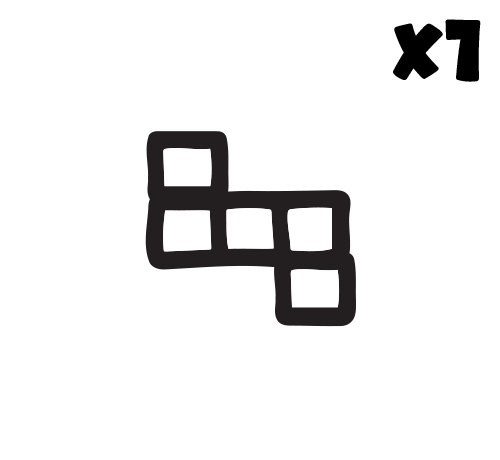
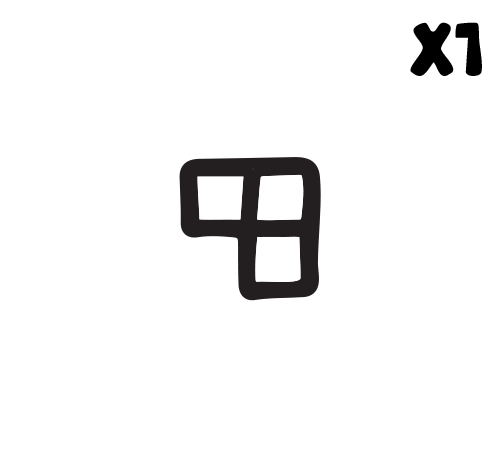
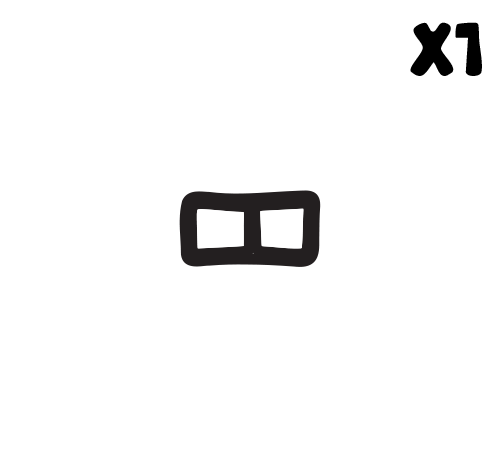
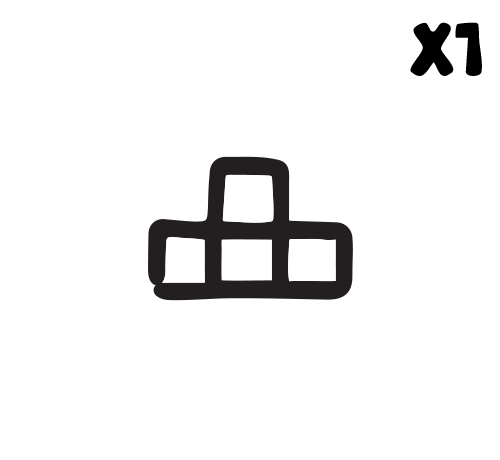
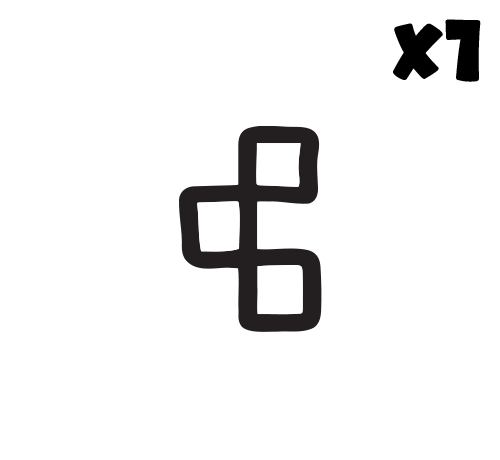
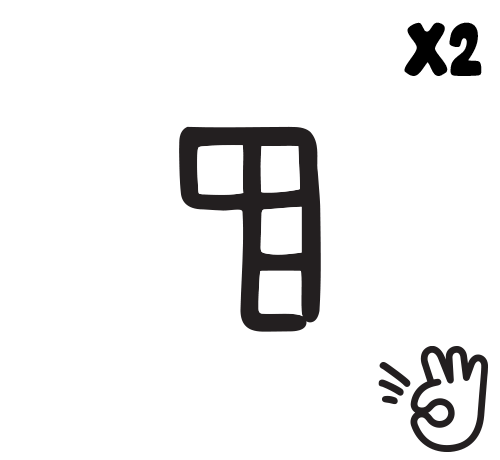
ELEMENT SHAPE: The shape in the center of the card shows the element gained during that turn.

NUMBER OF ELEMENTS: The ×1, ×2, or ×3 symbol shows how many elements are gained. The same rules shown on the card apply to all of them.
If a card gives more than one element, the elements may also be added to each other. In this case, they must touch along at least one edge of a square. Touching only at the corners does not create a connection.

PLACEMENT DIRECTION: The arrows show the directions from which an element can be added. If a card shows more than one direction, the player may choose one of them for each element gained.
If no direction is shown, the player decides where to use the element.

ROTATING AN ELEMENT: The rotation symbol allows an element to be rotated freely before it is drawn. All other information shown on the card still applies.
The rules shown on the card apply unless the selected game variant states otherwise.
GAMEPLAY
Players take turns. On each turn, the player draws a card, reads the information shown on it, and uses the gained element or elements according to the rules of the selected game variant.
If any of the gained elements cannot be placed according to the information on the card and the rules of the selected variant, they remain unused.
Once the move is complete, the next player takes a turn.
END OF THE GAME
The conditions for ending the game depend on the selected FORMFINITY variant. Each variant has its own objective and determines how the winner is decided.
VARIANT 1
SQUARES IN A LINE
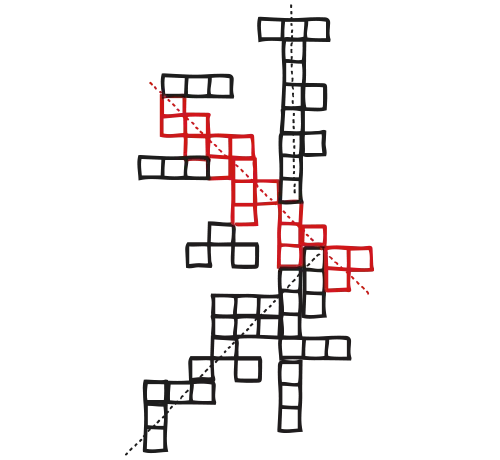
In this variant, 2 to 4 players use one shared template. Each player uses a different color pen.
The goal is to claim 4 lines, each consisting of 8 connected squares.
Lines may run horizontally, vertically, or diagonally and may include squares drawn by different players. The player whose move completes a line claims it.
Before starting the game, players choose one of two difficulty levels.
- EASY: Lines may cross and share squares. The same square may be part of more than one completed line.
- HARD: Lines cannot share squares. Each square may be part of only one completed line.
OBSTACLES
The template contains black squares that act as obstacles. No part of a gained element may be drawn on a black square.
WINNER
The first player to claim 4 lines wins.
VARIANT 2
FILL THE AREA
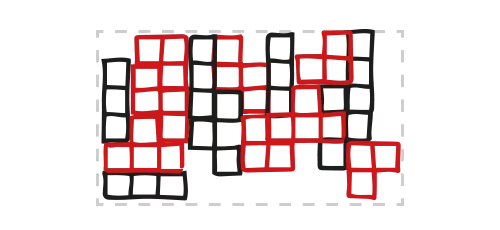
In this variant, 2 to 4 players use one shared template. Each player uses a different color pen. The directions shown by arrows on the cards do not apply.
The goal is to score as many points as possible by filling areas with the gained elements.
The template contains areas of different shapes and sizes. At the beginning of the game, players choose the first area they will fill.
The player decides where to place a gained element within the area currently being filled. Whether the element can be rotated is still determined by the card. No part of the element may extend beyond the boundaries of the area.
If a player cannot place any of the elements gained during the turn, the player’s turn ends.
An area is finished when it is completely filled or when every player, in turn, is unable to place any of their gained elements within it.
Once an area is finished, players choose the next one and begin filling it.
The game continues until all areas on the template have been completed.
SCORING
Each filled square is worth 1 point.
After completing each area, players count the squares in their colors and record their points.
WINNER
After all areas have been completed, players add up their points.
The player with the most points wins.
VARIANT 3
BLACK SQUARES
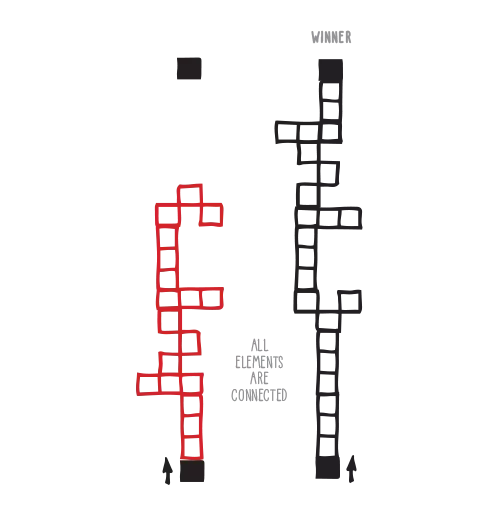
In this variant, two players use one shared template. Each player uses a different color pen.
The goal is to create an unbroken connection between the two black squares.
One player starts at the bottom black square and builds a connection toward the top one. The other starts at the top black square and builds a connection toward the bottom one.
Gained elements are added one by one to the growing connection according to the information shown on the card. Each new element must touch a previously drawn element belonging to the same player along at least one edge of a square. Touching only at the corners does not create a connection.
One player’s elements cannot touch the other player’s elements, either along an edge or at a corner.
WINNER
The first player to create an unbroken connection between the two black squares wins.
VARIANT 4
CONNECT THE NUMBERS
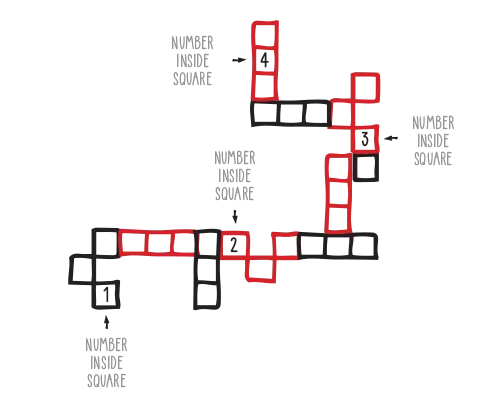
In this variant, two players use one shared template. Each player uses a different color pen. The directions shown by arrows on the cards do not apply.
The goal is to claim as many numbers as possible. Numbers must be claimed in order, starting with 1.
Players take turns gaining elements and deciding where to place them. Whether the elements can be rotated is still determined by the card.
Each new element must connect to previously drawn elements along at least one edge of a square. Touching only at the corners does not create a connection.
To claim the next number, a player must draw an element so that the square containing that number is covered by the element. The player whose element covers the square with that number claims it.
Numbers must be claimed in the correct order. An element cannot cover a number that is not currently being claimed.
If a player gains more than one element, they may claim more than one number during the same turn, as long as the numbers are claimed in the correct order.
WINNER
The game ends when all numbers on the template have been claimed.
The player who claims the most numbers wins.
YOUR GAME, YOUR RULES
FORMFINITY does not have to end with the four variants presented here.
The game includes a blank template that allows players to create their own game variants. You can change the objectives, introduce new rules, add obstacles, and experiment with the elements gained during play.
Your own variant can be simple or more challenging. The important thing is to establish the rules before starting the game and see how they work in practice.
If players create an interesting variant and would like to share it with others, they can send it to 8doodles. Selected ideas may be published as additional FORMFINITY variants.
Because in FORMFINITY, new rules can mean a completely new game.
Ready to play?

















 Roll & Write Game by 8doodles